top of page

Understanding the Science Behind Lyme Disease
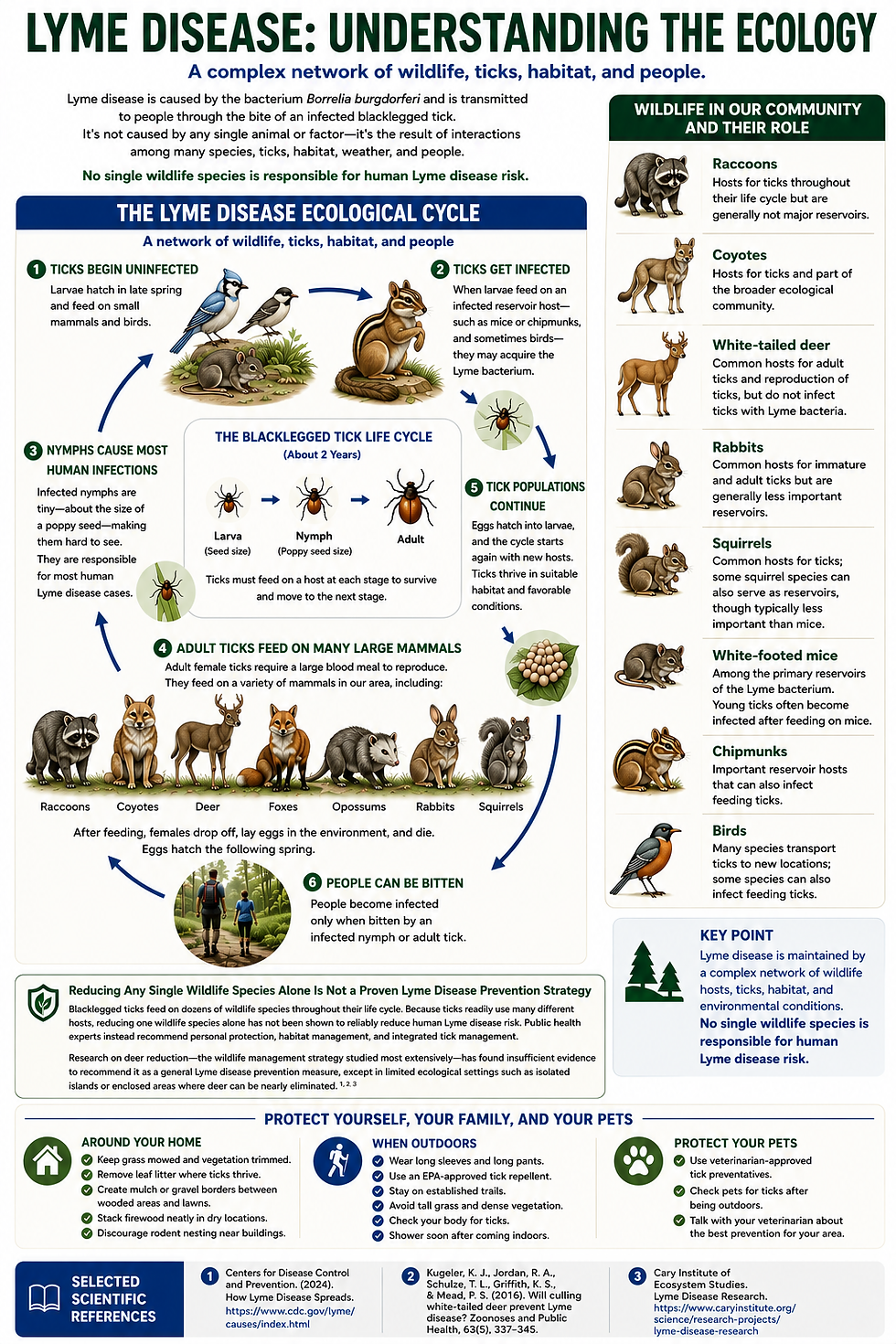
Lyme disease is a serious public health concern, and understanding how it spreads is the first step toward protecting ourselves, our families, and our pets. While many people associate Lyme disease with deer, the science tells a more complete story. Lyme disease results from a complex interaction among ticks, wildlife, habitat, weather, and people.
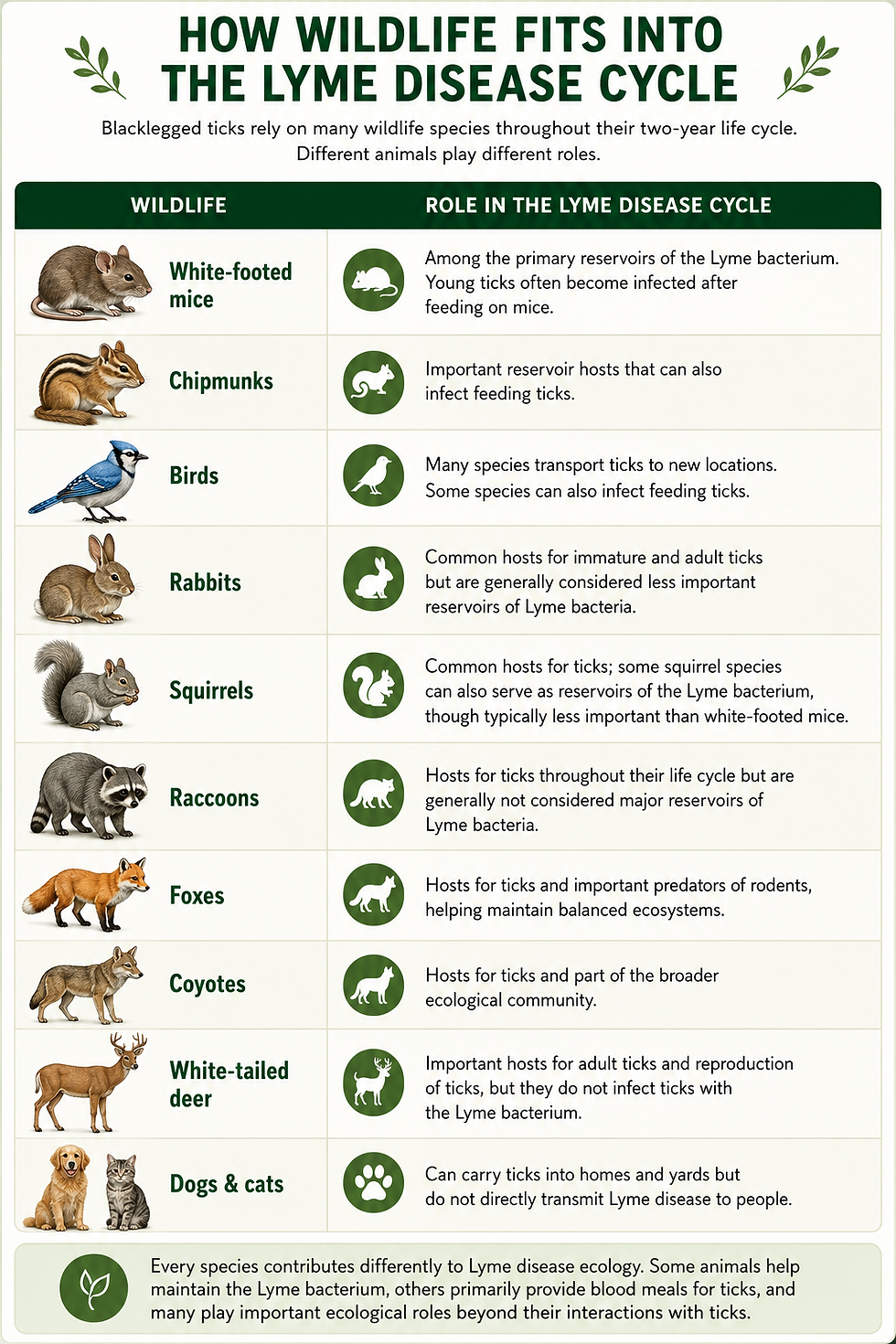
Blacklegged ticks rely on many different wildlife species throughout their life cycle. Some animals help maintain the Lyme bacterium in nature, while others simply provide blood meals that allow ticks to survive and reproduce. Because so many species and environmental factors are involved, no single wildlife species is responsible for human Lyme disease risk.
The most effective approach is not to focus on one animal, but to understand the ecology of Lyme disease and take practical steps to reduce our exposure to infected ticks.
The Big Picture
Lyme disease is caused by the bacterium Borrelia burgdorferi. People become infected only through the bite of an infected blacklegged tick.
Ticks have a two-year life cycle consisting of larval, nymph, and adult stages. During that time they feed on a variety of wildlife species. Young ticks hatch uninfected and may acquire the Lyme bacterium after feeding on infected reservoir hosts such as white-footed mice or chipmunks. As they mature, ticks continue feeding on many different mammals and birds before reproducing.
Most human Lyme disease cases are caused by infected nymphs because they are extremely small—about the size of a poppy seed—and often go unnoticed.
Because Lyme disease involves many wildlife hosts and environmental factors, no single wildlife species is responsible for human Lyme disease risk
How You Can Reduce Your Risk
Around Your Home
· Keep grass mowed and vegetation trimmed.
· Remove leaf litter where ticks thrive.
· Create mulch or gravel borders between wooded areas and lawns.
· Stack firewood neatly in dry locations.
When Outdoors
· Wear long sleeves and long pants in tick habitat.
· Use a repellent if necessary.
· Stay on established trails whenever possible.
· Avoid brushing against tall grass and dense vegetation.
· Perform a full-body tick check after spending time outdoors.
· Shower soon after coming indoors.
· Trail design that keeps paths clear of overhanging brush reduces tick contact for hikers and dog walkers
Protect Your Pets
· Use veterinarian-approved tick preventatives.
· Check pets for ticks after walks.
· Talk with your veterinarian about the best prevention program for your area.
What Doesn't Work: Reducing the Deer Population
You'd think fewer deer means fewer ticks means less Lyme disease. Scientists actually tested this, and it didn't work out that way.
In New Jersey, one town cut its deer population almost in half — from about 46 deer per square kilometer down to about 24. That's a huge reduction. But afterward, the number of ticks in the area barely changed.
Why? Scientists who studied this for over a decade found something surprising: the number of deer in an area doesn't really predict how many ticks — or how much Lyme disease risk — you'll have. They tracked deer numbers changing by three times or more over 13 years, and it made no real difference to tick populations the following year. What did predict tick numbers was how many mice and chipmunks were around the year before, and how many acorns had fallen two years before that (acorns feed the mice, more mice means more ticks get infected).
There's an even bigger red flag for the "deer causes ticks" idea. In one long-running study, researchers found a pattern that looked like fewer deer = fewer ticks — but when they removed just one unusual data point from the study, that pattern completely disappeared. That's a sign the original pattern wasn't a real cause-and-effect relationship. It was probably a coincidence in the data.
Bottom line: The evidence doesn't show that killing some deer helps a little, and killing more deer would help more. It shows that deer numbers just aren't the thing driving Lyme disease in real neighborhoods like Montclair. The real culprits are much smaller — mice and chipmunks.
The bottom line
Lyme disease prevention that works focuses on ticks and their small-mammal hosts. Framing deer or other larger mammals as the source of the problem doesn't match the biology. A safer, more effective approach means investing in personal protection, habitat management, and reservoir-targeted tools.
.
How You Can Reduce Your Risk
Around Your Home
· Keep grass mowed and vegetation trimmed.
· Remove leaf litter where ticks thrive.
· Create mulch or gravel borders between wooded areas and lawns.
· Stack firewood neatly in dry locations.
When Outdoors
· Wear long sleeves and long pants in tick habitat.
· Use a repellent if necessary.
· Stay on established trails whenever possible.
· Avoid brushing against tall grass and dense vegetation.
· Perform a full-body tick check after spending time outdoors.
· Shower soon after coming indoors.
· Trail design that keeps paths clear of overhanging brush reduces tick contact for hikers and dog walkers
Protect Your Pets
· Use veterinarian-approved tick preventatives.
· Check pets for ticks after walks.
· Talk with your veterinarian about the best prevention program for your area.
EXCITING innovations are on the horizon:
"A new approach to fighting Lyme disease could one day be as easy as buying a bag of garden pellets from a home improvement store.
Researchers at The University of Texas at San Antonio are developing a non-toxic biologic designed to reduce the spread of Lyme disease before it reaches people or pets. Rather than focusing on treating humans, the team is targeting the small wild animals that help spread the bacteria to ticks in the first place."
Newsweek, July 1, 2026
What Doesn't Work: Reducing the Deer Population
You'd think fewer deer means fewer ticks means less Lyme disease. Scientists actually tested this, and it didn't work out that way.
In New Jersey, one town cut its deer population almost in half — from about 46 deer per square kilometer down to about 24. That's a huge reduction. But afterward, the number of ticks in the area barely changed.
Why? Scientists who studied this for over a decade found something surprising: the number of deer in an area doesn't really predict how many ticks — or how much Lyme disease risk — you'll have. They tracked deer numbers changing by three times or more over 13 years, and it made no real difference to tick populations the following year. What did predict tick numbers was how many mice and chipmunks were around the year before, and how many acorns had fallen two years before that (acorns feed the mice, more mice means more ticks get infected).
There's an even bigger red flag for the "deer causes ticks" idea. In one long-running study, researchers found a pattern that looked like fewer deer = fewer ticks — but when they removed just one unusual data point from the study, that pattern completely disappeared. That's a sign the original pattern wasn't a real cause-and-effect relationship. It was probably a coincidence in the data.
Bottom line: The evidence doesn't show that killing some deer helps a little, and killing more deer would help more. It shows that deer numbers just aren't the thing driving Lyme disease in real neighborhoods like Montclair. The real culprits are much smaller — mice and chipmunks.
The bottom line
Lyme disease prevention that works focuses on ticks and their small-mammal hosts. Framing deer or other larger mammals as the source of the problem doesn't match the biology. A safer, more effective approach means investing in personal protection, habitat management, and reservoir-targeted tools.
.
bottom of page